Total views : 59185
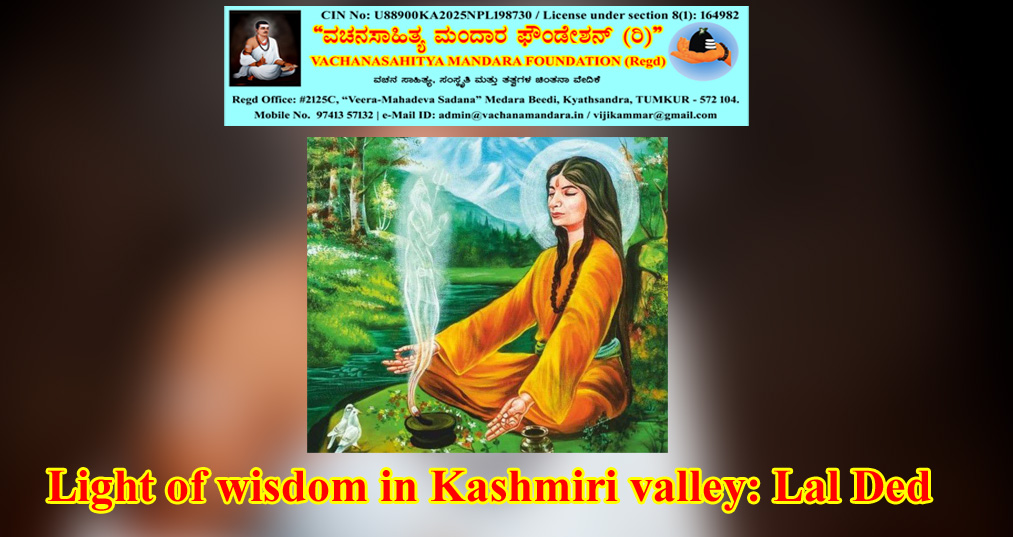
There may be no University gate, no memorial, or no birthplace cenotaph to remember and pay our obeisance to Lal Ded, but one Lal Ded Hospital named after Laleshwari, the 14th century mystic poetess from Kashmir, reminds us of her divinity. Lal Ded hospital in the heart of Srinagar city, near the banks of Vitasta, at the now dismantled old Fruit Mandi complex, is the place where the Lord Creator bestows motherhood to innumerable women. This is the place where Lord grants life to generation after generation of Kashmiris; hence most befitting place to name after Lal Ded, whose Sanskritised Kashmiri Shaivite verses have channelled generations for centuries and ensured Kashmiri language a place in the world poetic arena.
The name Lal Ded is an open compound name formed by using two words Lal and Ded. To my understanding Lal is the short form of Lalita, that is associated with our Goddess Lalitha Tripura Sundari, the goddess of Creation, Preservation, and destruction. This also means Beautiful, elegant and graceful. In Kashmir this Lalitha or Tripura Sundari is worshiped by the sadhakas of Kashmir Shaivism in the practice of Srividya. She is also considered to be a form of Maharagni. Those of us who recite Lalitha Sahasranama (Bhramanda Purana) know that the Sahasranama starts with the recitation of her name as “Shrimata Shri Maharagni”. She is also addressed as Bhavani. Thus, the name Lalitha in Kashmiri becomes Lalla and its diminutive form is Lal. Regarding the word Ded, I believe the word is an Apabhramsa or distorted form of the Sanskrit word Dida. Sir M Monier Williams, the Professor of Sanskrit at the Oxford University, informs us in his famous Sanskrit English dictionary that the word Dida means brave and one who takes care. In this context we know that Kashmir was ruled by a great queen Didda from 958 CE to 980 CE. Historians have recorded that queen Dida was so loved by his people that with reverence they started calling their grand and great mothers as Dida. In Kashmir Dida was so strong that coins were issued in her name. This Dida gradually became Ded, pronounced as Dyed. Until very recent past we called our grandmothers as Ded like Beni Ded, Kak Ded, Heemal Ded or simply Ded. With this background Lalitha or Lalleshwari became Lal Ded, the grand Lalla. And it is no coincidence that in Crotian language, Ded means a grandfather.
I have often observed that we generally call her Shiv Yogini. It may be true, but I apprehend that we may not be able to understand this term properly. We know that Lord shiva is the first Yogi so his devotee can be called a Yogi or a Yogini. But we should not connect Lal Ded, the Shiv Yogini to the modern-day yoga, whose basis is the Yog Sutra of Patanjali. Here Yoga refers to tantra Yoga, one of the six branches of Yoga. The earliest mention of the word Yoga is mentioned in Rig Veda in its first Mandala. “Sa Dhinam Yogam invati”. He promotes the Yoga of thoughts(1.18.7) Yog Sadhana seals and fossils, dating back to 2700 BC, have been recovered from Indus Valley civilization cites in which people are seen practicing Yog sadhana.
To understand why Lal Ded is called a Shiv Yogini, we need to understand the Tantric Practices of Kashmir Shaivite Tantra. For Shaivites, Yoga is the process of the realization of the supreme reality and a Yogi or Yogini is one who have attained self-realization. A yogi is one who attains the highest Truth as propounded by the Lord Shiva and where the Truth is the Lord Shiva himself. Kashmir Shaivism teaches techniques and methods to achieve this Yoga hood. In Tantra Loka, acharya Abhinav Gupta, quoting his guru, Sambhunath describes this yogic state as Jagadananda. A state where Anand, the bliss is found shining. In Shaivism, Shiv Sutras have been accepted as the Yoga of supreme identity. A Yogi/Yogini is one who understands the ultimate reality. As the Sutra” Vismayo Yoga Bhumikah” (Sutra. 1.12) Acharya Khemraj in his commentary of Shiv Sutras, explains that a yogi has this experience in himself that is full of uninterrupted joy. “Prayatnah Sadhakah” (Sutra. 2.2) For attaining this state one must keep on trying until he achieves this uninterrupted joy. And realizes the ultimate truth. That seeker becomes a Yogi/Yogini.
Lal Ded has described her practices and even failures in many of her Vaks. like the following one.
Vakh:
Lal bo chayas somane bagh baras
Vochum Shivas Shakhit meelith te wah
Tati lai karmas amrit saras
Zindai maras te me kari kya
Translation:
Upon entering the jasmine garden of my heart, I found Shiva and Shakti in unison. It was there that I immersed in the sea of the nectar of bliss. Now I have handed over myself to the Lord and overcome the worldly death. This state of highest bliss however cannot be achieved without a Guru.
“Gurur Upayah” (Sutra.2.6) “Spiritual transformation requires a Guru, a teacher. And “Shivatulyo Jayate” (Sutra. 3.25). One who achieves self-realization becomes one with Shiva. And he is a Yogi or Yogini.
In Kashmir Shaivism, the Ashtanga Yoga is also recognized. Revered Swami Lakshman Joo calls them eight limbs of yoga. But he also explains as to how in Tantra Loka, Abhinavagupta acharya has recognized only six of them. The eight are Yama, Niyam, Asana, Pranayama, Pratihara, Dharna, Dhyana and Samadhi. “Malini Vijayottara Tantram” describes Yogin as one who is necessarily conjoined with the manifestation of his nature. However, in Tantric tradition acharya Abhinav Gupta propounds six corner stones or methods of Yoga. They are Pranayama, Pratyahara, Dhyana, dharna, Tarka and samadhi.
Yoga means complete withdrawal of the mind. A pre requisite for this yoga is initiation. That is one of the six limbs as they call it. Yoga of the Shri Malini Vijayottara Tantram contains a study of the yogic teachings of Trika and it also emphasis upon initiation, worship, and menta and bodily discipline. With regard to initiation, in Kashmir Tantric practices, there is a sect of Shiv Yoginis particularly in the Kaula tradition. One is astonished to read and know that in Kaula tantric tradition, Yoginis cults were central to its practices. They were a group of powerful female divinities with whom female witches were identified in ritual practice. Their power was intimately connected to the blood, both their own sexual and menstrual emissions and blood of their animal sacrifices victims. They were essential to tantric initiation in which they initiated male practitioners through fluid … … … It is mentioned that a hallmark of Yoginis was polymorphism. They took the form of humans, animals or birds and often inhibited trees. Their temples were generally located in isolated areas on hill tops or in isolated areas. Lal Ded however it seems did not belong to that cult. She was a Yogini as we described the one who was a realized soul and had attained the realization of ultimate truth.
A Yogi or Yogini is one who is free from all the pain and the pleasure. Who is Sam Drishti, Sam Sukhe Dhuke. She had eliminated all her impurities, the Malas (Impurities), Anava Mala, Maya Mala and karmika Mal. She had mastered all the Upayayas the Sambhavaopaya, Shaktopaya and the Anavopaya. These are evident in her Vaks. We learn and understand more when we read Lal Ded after reading and understanding at least the basics of Kashmir Shaivism.
Lalla’s poetry is called Vak, Lal Vak. George Grierson, who did some pioneering work on these Vaks called his work as Lalla- Vakyani, ‘the wise sayings of Lal Ded’. Lal Ded’s poetry has today become a form of poetry. Those who write in this form of four liners in which Lal Ded expressed herself claim to be using Vak metre / Chanda (Chandassu), the poetic form. My understanding is that Vak is not a simple word and not a meter or a form of simple poetry. As explained below, Vak is the ‘category’ of speech, a divine expression. To explain my point, I quote here what the pioneer of ‘Chhando darshan’ the study of meter in Sanskrit, Maharishi Devavrata has to say. He explains that:
Vak is that word that remains there forever even after the dissolution of this universe.’ Vak existed before the universe came into being. The difference between a simple word and a Vak, according to him, is that a word vanishes once the listener listens and comprehends.
A Vak does not vanish. Vak has the status of Brahma. Vak, like Brahman the pure consciousness is supreme and pervades like that. Vak, says he, is the supreme deity as she is the power of Shakti of the highest reality. We first find the mention of the word Vak in Rigveda. Rigveda describes speech as Vak. In Rigveda, the deity of speech Vak has been praised for her greatness and attributes. She imparts the divine knowledge and purifies the mind.
The Vak is referred to as the Hymn of creation. In the 10th mandala of the “Na-Asdiya Sukta”, Sukta 125 Vaak is depicted as the force behind creation, the source of knowledge and the inspiration for poets and seers. Kashmir Shaivism explains this further. Shaiv Acharya Moti Lal Pandit, in his book ‘An introduction to the philosophy of Trika Shaivism’ says:
The absolute in its absoluteness is spoken of as the Transcendent Word (Para-Vak). When tendency (unmukhata) towards manifestation arises in the word, it descends to the visionary (Pashyanti) stage and from the visionary stage the descent occurs towards the middling (Madhyama) and finally towards the gross (Vaikhari) stage.
Stages of Vak are the stages of the manifestation of the word and they are compared to the four stages of consciousness. First two being action, (Kriya), and the Knowledge (Jnana). Maharishi Devavrata say that in earlier times Vak was used to introduce a new born to the world of Vaikhari. It was believed that by speaking holy words in the ear of the new born, the new born becomes wise in due course. Thus, holy Vak was being repeatedly told in the ear of the new born. This practice is still prevalent in Kashmir, where Muslims religiously practice this but instead of Vak, they speak Azan (Call for prayers) into the ear of the new born irrespective of gender. The natural question that arises is then why do Hindus of Kashmir not follow this practice. Historian Dr. K. N. Pandita has the answer. He says it is ‘because the repeated exoduses of Hindus demolished all their traditions and customs. Whatever little the community could pursue and follow in alien lands was some rituals that relate to birth and death. Like birthdays and last rites or some rites during marriages etc.’
With the passage of time and with historical and political considerations Vak became the poetic genre in which Lal Ded has expressed and conveyed her mystic message. This form of four-line poetic stanzas has also been adopted by many poets and is still very prevalent though not to that extent. Those who adopted this form include Shivite poets like Roop Bhavani, Swami Tika Ram Ganjoo popularly known as Tika Kak, ( He lived at Madanyar Habba Kadal Srinagar), Swami Bhona Kak (He lived in Pinglin Pulwama)), Swami Mirza Kak , popularly called Kak Ji, (He lived at Hangal Gund near Kokernag, the famous tourist place that got its name from the ancient Tirtha of Koteshwar Mahadev) , Swami Thakur ji, Swami Paramananda of village Seer near the famous Martand temple in Anantnag and Swami Mirza Kak and Master Zinda Kaul ( 20th century poet from Habba Kadal Srinagar) to name a few. Kashmiri Muslim mystic poets called Sufi poets like Swachh Kral and Samad Mir also wrote poetry in this form. Many Lal Vaks of Lal Ded are available today wherein the lines number more than four. Few Vakhs of Tika Kak and Bhona Kak are available in a couplet form and they have so mingled that according to Dr. B. N. Pandit, it was difficult to pinpoint who wrote which Vak. Shaivite scholar and the translator of Ishvara Praytabhijna Karika of Utpaladeva Dr. Baljinath Pandit tells us that Lal Ded adopted that style of poetic prose which was already prevalent among Shaiva saints, who wrote in Pratinta (Direct) and Aparatinata (indirect) languages and quotations from whose works are available in some important works of Abhinavagupta. That style was later called the style of Vaks. Explaining this Moti Lal Pandit says ‘Vak means the word, as Vyakhyan in Sanskrit, but not the simple word. It is that word which reveals the ultimate truth’. This is that mode of expression or style of poetry, at the stage of Vaikhari, in which the author addresses the reader directly and reveals to him/her the mystery of the creation. Vak is the dialogue with the people that conveys the Shaivite thought. That is why Lal Ded poetry is called Vak. This statement is very significant because almost entire poetry of Lal Ded is in this style. Her Vaks are a direct dialogue with the reader/listener. She is directly addressing the audience.
Vakh:
Kehnas pethey kya choye nachun
Mochey kenh ne te nachun traav
Pot pheerith chye totoye achun
Youhai Vachun cheats thaav
Translation:
Why are you thrilled, there is no basis?
Cast off rejoicing, there is no achievement
Ultimately you must return, from where you came
Keep in mind this very counsel
Other than the Vak, Lal Ded has also used the word Vachun, that I am sure is the word Vachana but pronounced as Vachun in Kashmiri. She has used this word Vachun (Vachana) more than once. Sanskrit word Vachana is that word that communicates orally. Vachana as noun is also a number like ekavachana and bahuvachana (Singular/Plural). However, in Shaivite thought this is used to convey the mystic knowledge.
Vakh:
Gurun dopyum koney vachum
Nebrh dopnam andar achun
Soye me lali give vac te Vachun
Tavai hyotum nangai nachun
Translation:
My Guru initiated me to one mantra
Move from exterior to interior, he said
To me that became Vac and Vachun
And I started dancing (Naked) in ecstasy.
This expression of naked dance has been discussed and deliberated by many scholars, with some distorting the expression and some arguing against. I however draw a parallel between Akka Mahadevi another mystic poetess from Karnataka and Lal Ded, whose life has almost been identical. The southern poetess was very much fond of her love for Chennamallikarjuna (Formless God Shiva). It is said that when her husband (King Kaushika) wanted to consummate the marriage, she refused and when he forced himself upon her and tried to undress her by force, she did not allow him. To revenge him and to give him a befitting reply in metaphysical terms, she abandoned her clothes for ever and covered her physical body only by her hair. She is also said to have roamed naked. She, like Basaveshwara, is not only remembered today as a Lingayat, but also as a saint of highest order. He outpouring too is called Vachana. Now this nakedness is not nudity. In metaphysical terms, the nakedness of the physical body could easily be taken as free from all the worldly attachment, where the body, that keeps the soul (the inner consciousness) is as pure and holy that no worldly impurity can dilute its divinity.
Coming back to Vachun or Vachana, the Vachun is a very popular form of Kashmir poetry also. Prominent mystic poets like Samad Mir and Swachh Kral’s large portions of poetry have been called Vachun. Habba Khatoon’s ‘Ghazal’ poetry is also called Vachun. However, Kashmiri Vachun is totally different from the Vachana of Lingayat poets. This has wrongly been used by some scholars in Kashmir. However modern scholar like Sahitya Akademy award winner scholar Basher Bashir agrees with me and expresses doubt about Habba Khatoon’s poetry being Vachun or Vachun being what we have made it to mean. Vachun, no doubt is the Kashmiri form of the Sanskrit word vachana. Lal Ded using this term denotes nothing but the meaning in which the Vachanakaras of Kannada Vachana poets of Lingayat movement have given to this.
History tells us that Kashmir and Karnataka in particular have had ancient links. It is not in isolation that Bilhana reached Kalyan and became the court poet of the Chalukya king, Vikramaditya (1076-1126). Our only difficulty in understanding this link is lack of research on the subject in the modern times Edward P Rice who has authored the book “A history of Kannada literature” has characterized Vachana poems as brief parallelistic allusive poems each ending with one of the popular local names of Formless God Shiva (Nirakara Shiva) and preaching the common folk detachment from worldly pleasures and devotion and adherence to Lord Shiva. There is a trinity of Lingayatism. They are Allam Prabhu, the 12th Century mystic saint and Vachana poet, Basaveshwara and the Akka Mahadevi.
Kannada saint Shri Hangal Kumaraswami who established the All India Vira Shaiva Mahasabha in 1904, leads us to a direct connect between the Shaivite scholars and followers of the two regions in his book on Vira Shaivism. He narrates the story of a king of Kashmir who voluntarily abdicated his throne to follow the principles of Basaveshwara. His name is given as Marayya and his wife is named as Mahadevi. Would this be an isolated case … … no, Kashmir was the seat of learning. Scholars did visit to and from Kashmir. H. H. Shri Kumarswami, who interpreted Vachana literature, relates in one of his articles the story of a King of Kashmir who voluntarily abdicated his throne to follow the principles of Basaveshwara and live up the gospel of Kayaka (Profession). Marayya’s Kayaka was to sell firewood. Hence his name is Molige Marayya. His wife was Molige Mahadevi. Here we must also make a mention of Bontha Devi, who was a princess of Kashmir and who in 12th century went to Karnataka and produced Vachana poetry’. She wrote under the name of “Bidadi” means a wandering Shiva.
Author of the book Akka Mahadevi, Mukund Rao admits that we do not know much about her, but Suvarna V Patil in her article published in the international Journal for multidisciplinary research says that Bonta devi’s Six vachanas are available with the pen name Bidadi have been found. He has included one of her vachanas in his published article. In it she questions the caste system and insists upon equality of all humans. That is what Lal Ded also preaches.
Since we live in the age of social media, I have recently come across a post where it is said that Molige Mahadevi was a Kashmiri queen, who went to Kalyana with her husband. Her pen name is given as “Ennaya Priya Nihkalanka Mallikarjuna” and it is reported that her seventy Vachanas have been found. This all could not have been in vacuum. Unless the message of the Lingayat had reached Kashmir and influenced the seekers there, how could a person of the stature of a prince or a princes leave everything behind and move to be under the feet of Lord Bassaveshwara. And unless there was interaction between the two people, this could not have been possible. This demands a research and re-look.
Again, in Lingayatism preaching there has been a tradition of Guru who are called Jangama. Jangam the Sanskrit word that means to move or moving. Zangh the Kashmiri word. Vachanakaras had Jangamas, the Gurus who preached them Lingayatism through singing Vachanas, and they would always move from place to place. I am sure they must have visited Kashmir too. Kashmir, the home to Tantric Shaivism. And why is it that Lal Ded would not know Lingayatism that was there more than a hundred years prior to her birth. In Kanada the Lingayatism followers are called Sharanas. Those who seek refuge in the grace of Lord. In Kashmir, particularly in Bhakti poetry this word sharana is commonly used.
Vachana is the poetry of Lingayat saints and Vak (in its present form) is a the Shaivite form of poetry. How the concept of Vachana travelled from Karnataka to Kashmir or from Kashmir to Karnataka is not known, but what is known is that there is no doubt that Kashmir and Karnataka included enjoy historical connect. However, there is a vast difference between the two.
Maharishi Daivarata has explained Vak in some detail. He has given 52 synonyms of Vak, ‘rediscovering the concept of Vak from the Vedas, the Brahmans, and Upanishads’. While Vachana is essentially a non-lyrical prose, Vak is not non lyrical. While Vachana is a ‘spontaneous free verse’, a Vak is not. That is where Lal Ded uses both to explain teachings in both prose and poetry. Why Lal Ded chose poetic form of Vak may be due to strict adherence of Kashmiri scholars to ‘Chhanda’ metre. In Chhandomanjiri, it is mentioned that Kshemendra has explained in detail about the use of different metres and has categorised those poets as poor who do not use proper metres. It seems Lal Ded must have had certainly known what was happening in the southern and central parts or let us say other parts of India two centuries before her.
There is some similarity of message between Lal Vak and some Vachanas, and that is not merely the beauty of the similarity of the mystic experience. That essentially is the expression of the Shaivite practices. Like the above Vak of Lal Ded and this Vachana of Akka Mahadevi, where both say that:
Lord resides within’
When I did not know myself
where were you?
Like the colour in the gold,
you were in me.
I saw in you,
lord white as jasmine,
The paradox of your being in me
(English rendering by A. K. Ramanujan.)
And Lal Ded says:
Lal bo drayas lolare
Chandan loosum den kiho raat
Vochum Pandit panene ghare
Suy me rotnas nechtur te saath.
As I treaded on the road to seek Him,
I exhausted, searching for him
through day and night.
But ultimately, I saw Him in his own house (My heart).
And that was the time, I realise.
I find a lot of similarities between Lal Ded’s Vaks (Vacs) and Vachanas of not only Akka Mahadevi but those of Basaveshwara as well. It is a matter of not only deep research, but also of co-operation and co-ordination. I wish some government institution helps me.
Now see this Vachana of Akka Mahadevi:
People, male and female,
blush when a cloth covering their shame comes loose
When the lord of lives,
lives drowned without a face in the world,
how can you be modest?
When all the world is the eye of the lord,
onlooking everywhere, what can you cover and conceal?
(www.poemhunter).
And Lal Ded says:
Moodo Kry chai ne dharun te paarun/Moodo kray
chai ne rachen kaai Moodo kray chai ne
deh sandaarun/Sahz
vecharun choy vopdesh.
Oh, ignorant one, shaping and beautifying
this body is not the Karma.
Understand, your aim should be to seek the Lord,
not this body
In another Vakh Lal Ded says:
Gaal Kadnam bol padnam/Dapnam
ti yes ye roche Sahaz kusmav
pooz karnam/ Bove ami laene
te kas kya moche.
Even if they call me names or
worship me with flowers.
That all is immaterial
for me as I am on a different path
Akka Mahadevi says:
Having built a house in a market place
Why fear the noise
Oh, Lord Chennamallikarjuna
Having born in this world Without resentment
one must bear The praises and accusations
Calm and composed.
(English by Dr Vijaya Subbaraj)
I am sure there were saints and poets in Kashmir who had followed Basava, but unfortunately as on today, no literature is available. Though we have many leads that need to be followed. And for me the search continues.
With regard to Lal Ded, I reject all the whimsical anecdotes attributed to her. If we accept that she was a Shiv Yogini, then we must accept that in Shaivism doing miracles is strictly prohibited. All such things attributed to her are merely a result of socio-political scenario of her period. And unfortunately, later generations have continued to authenticate the false narrative. And even in this they are confused. One person writes in his book that “and the other comes on YouTube to proclaim her conversion of faith. To both, I say learn Kashmir Shaivism and then read Lal Vaks, you will realise that she is a Shiv Yogini in the real sense of the term.
(The credit of Vachanas copied from google and used here goes to their respective collectors and translators)
You can visit our youtube channel to listen this presentation.
Shri. Brij Nath Pandit Watloo “Betab”.
Poet, Journalist, broadcaster, and writer
Jammu.
Mob No. 96229 68181.
- Readres kindly contact the author directly for any queries and clarifications.
- Contact details of Vachanasahitya Mandara Foundation (Regd):
- Mob No. 9741 357 132.
- e-Mail ID: info@vachanamandara.in / admin@vachanamandara.in